
Introduction: Why Understanding Digital History Is Your Best Future Strategy
Imagine walking into a corporate boardroom in the early 1990s to pitch a marketing campaign. Your entire arsenal would likely consist of print advertisements in glossy magazines, high-budget television spots, radio jingles, physical billboards, and direct mail flyers. Measuring return on investment (ROI) was notoriously vague. John Wanamaker’s famous century-old quote held strictly true: “Half the money I spend on advertising is wasted; the trouble is I don’t know which half.”
Fast forward to today, and marketing operates in a completely different universe. Decisions are driven by real-time data analytics, automated bidding algorithms, programmatic placements, hyper-targeted consumer segments, and predictive artificial intelligence. Modern brand interactions happen across multi-touchpoint attribution modeling pipelines where every click, scroll, hover, and conversion can be measured and optimized.
As Digital Puneet Bedi, I frequently tell founders, marketing directors, and ambitious business owners that digital marketing is not merely a collection of software tools or social media channels. It is an ever-evolving ecosystem rooted in human psychology, technological capability, and media consumption habits.
If you view digital marketing as just “running ads” or “posting on social media,” you will always be reactive—scrambling whenever an algorithm changes or a new channel emerges. However, when you understand the historical evolution of digital marketing, you unlock a macro-level roadmap that allows you to anticipate industry shifts, build resilient growth engines, and outpace your competition.
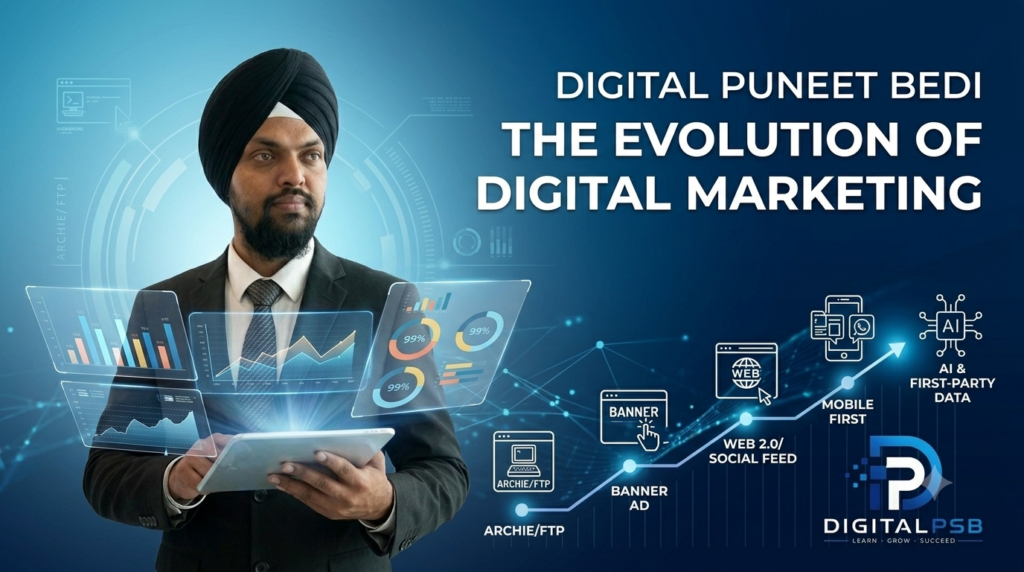
To truly understand how we arrived at today’s AI-driven landscape, we must categorize the last three decades into four distinct structural eras: from 1970 to 2020:

If you walked into a marketing department in 1990, the standard toolkit was clear: print ads, cold calling, direct mail, and TV commercials. The goal was broad reach, and measuring exact ROI was closer to art than science. Fast forward to today, and marketing is data-driven, real-time, hyper-personalized, and powered by artificial intelligence.
How did we get here? As a digital marketer, understanding where our industry started isn’t just a history lesson—it’s a map for where we’re going next.

1. The Dawn of the Web (1990–1999): Web 1.0 & The First Click
The term “Digital Marketing” was coined in the early 1990s alongside the birth of the World Wide Web and Web 1.0. In 1990, Archie—the world’s first search engine—was launched to index FTP sites, setting the stage for organized online information.
The real turning point for digital advertising happened on October 27, 1994. Wired magazine’s digital arm, HotWired, ran the first-ever clickable banner ad for AT&T. It read: “Have you ever clicked your mouse right HERE? You will.”
The result? An extraordinary 44% click-through rate (CTR)—a figure modern performance marketers can only dream of

During this decade, search engines like Yahoo! (1994) and Google (1998) emerged. Marketers realized that having a website was worthless if people couldn’t find it, giving birth to Search Engine Optimization (SEO).
2. The Golden Era of Search & Social (2000–2009): Web 2.0 Takeover
The dot-com crash in 2000 cleared out speculative noise, leaving resilient infrastructure behind. This ushered in
Web 2.0—a shift from static, read-only websites to interactive, user-generated web platforms.
Key Developments:
-
Pay-Per-Click (PPC): Google launched AdWords in 2000, fundamentally changing paid advertising by introducing auction-based intent targeting.
-
Social Media Boom: Platforms like MySpace (2003), Facebook (2004), and YouTube (2005) shifted marketing from one-way broadcasting to two-way community building.
-
Data & Analytics: Web cookies matured, enabling behavioral tracking, customer segment profiling, and basic retargeting.
Brands were no longer just shouting at consumers—they were building brand communities and analyzing user interaction paths.
3. The Mobile & Content Era (2010–2019): “Mobile-First” & Feed Algorithms
The launch of smartphones (accelerated by the iPhone) changed consumer behavior permanently. Desktop-only marketing strategies became obsolete almost overnight.

What defined this decade?
-
Responsive & Mobile Optimization: Google shifted to mobile-first indexing, making site speed and mobile user experience core SEO ranking signals.
-
The Content Marketing Boom: As traditional ad blockers grew, inbound marketing took off. Blogs, podcasts, long-form guides, and video content became primary drivers for lead acquisition.
-
The Rise of Influencer Marketing: Platforms like Instagram (2010) created a new creator economy where niche creators offered higher engagement and trust than traditional celebrity endorsements.
-
Programmatic Ad Tech: Real-time bidding (RTB) transformed how display ads were bought, automating placements across programmatic networks in milliseconds.
4. The AI & First-Party Data Era (2020–Present)
Today, digital marketing relies on automated intelligence, predictive analytics, and short-form video algorithms.

With strict privacy regulations (GDPR, CCPA) and the deprecation of third-party cookies, marketers are rebuilding strategies around first-party data, community building, and AI-driven hyper-personalization.
The Takeaway for Modern Marketers
Looking at this evolution reveals a clear trend: the channel changes, but the core principle remains the same.
Digital marketing moved from mass communication to intent-based search, then to social connection, and now to personalized algorithmic experiences. The marketers who succeed today aren’t just masters of tools or platforms—they understand user intent, tell stories, and adapt to technological shifts.
Search algorithms and AI summary engines reward comprehensive topic coverage. Include these specific historical milestones to capture long-tail keywords:
-
1993–1994 (The Birth): First clickable web banner (HotWired / AT&T with a 44% CTR) and the birth of search indexing (Archie, Yahoo!).
-
2000–2005 (Intent & Connection): Launch of Google AdWords, Web 2.0, user-generated content, and social networks (MySpace, Facebook, YouTube).
-
2007–2015 (Mobile & Inbound): Smartphone adoption, Google Mobile-First Indexing, response-based web design, and inbound content marketing.
-
2016–2022 (Programmatic & Creator Economy): Real-time bidding (RTB), algorithmic social feeds (TikTok/Reels), influencer marketing, and privacy changes (GDPR, cookie deprecation).
-
2023–Present (The AI Era): Generative search, AI-driven hyper-personalization, answer-engine optimization (AIO), and first-party data strategies.

-
Optimize for Zero-Click & AI Overviews: Place a 50-word summary table or bulleted timeline near the top. Search engines extract structured lists into featured snippets and answer modules.
-
Demonstrate First-Hand Expertise (E-E-A-T): Add commentary on how marketing strategies evolved, including original observations or practitioner perspectives rather than just dates.
-
Use Entity-Based SEO: Mention core concepts, key technologies, and influential figures consistently (e.g., Google AdWords, PageRank, Web 2.0, Programmatic RTB, First-Party Data).
-
Build Interlinking Hubs: Link this cornerstone article to secondary posts like “Top AI Marketing Tools” or “SEO Best Practices” to establish topical authority.