

PART
1: Introduction, Flight Details & The Mid-Air Incident
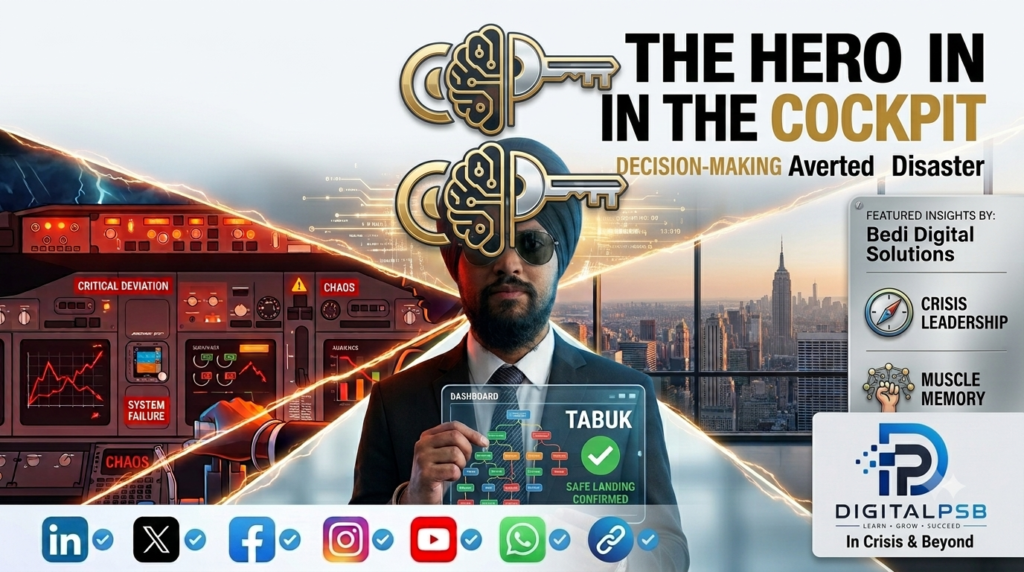
The Hero in the Cockpit: How Indian
Captain Smit Machchhar Averted a Mid-Air Disaster
Author / Digital Marketer:
Puneet Bedi (bedips.in)
1. Introduction: The
High-Altitude Nightmare
At 30,000 feet, cruising through
cold, thin air at 800 kilometers per hour, aviation safety relies on an
unspoken pact of trust. Passengers drift to sleep, watch movies, or quietly
converse with loved ones, comfortable in the knowledge that two highly trained
professionals sit behind a reinforced door, navigating the skies with
precision.
When that sanctuary inside the
cockpit is broken, panic can ignite in seconds. In commercial aviation,
catastrophic events rarely unfold like Hollywood movies with endless minutes of
dialogue. They happen in milliseconds. Control sticks drop, warning lights
flash red, and gravity takes over. In those razor-thin moments between disaster
and survival, leadership is no longer a corporate buzzword—it is the difference
between life and death for hundreds of human beings.
This was the terrifying reality
aboard a recent international commercial flight when an unthinkable emergency
erupted miles above the ground. What began as a standard flight quickly turned
into a high-altitude nightmare. Yet, what could have been recorded as one of
modern aviation’s worst human-factor tragedies became an enduring story of
resilience, extraordinary physical courage, and split-second decision-making.
At the center of this survival
story stands an Indian aviator: Captain Smit Machchhar. His composure,
muscle memory, and refusal to surrender control averted a devastating
catastrophe, preserving the lives of all 174 passengers and crew members on
board.

2. Seconds from Disaster: What
Happened in the Cockpit
The flight was smoothly
traversing its scheduled route when an sudden crisis developed inside the
flight deck. Without warning, the co-pilot suffered an acute behavioral
breakdown, initiating a sudden, violent physical assault on Captain Machchhar
while pushing the aircraft into a sharp, terrifying nose-dive.
As gravity shifted and g-force
pressed down on the airframe, oxygen masks dangled in the passenger cabin.
Alarms rang inside the cockpit while the nose of the Boeing 737 dipped sharply
toward the terrain below. In an instant, Captain Machchhar faced physical
trauma, disorientation, and a rapidly descending multi-ton aircraft.
The Decisive Countermeasure
Despite sustaining severe
upper-body injuries and facing intense physical pain, Captain Machchhar’s
training immediately kicked in:
- Reclaiming Aircraft Attitude: Fighting
against the controls with one hand while deflecting physical strikes with
the other, he leveled the aircraft’s wings and arrested the rapid descent.
- Emergency Protocol Execution: Recognizing
that he could not maintain control while under active physical assault,
Captain Machchhar made a critical tactical decision—he unlatched the
armored cockpit door lock mechanism from his control console.
- Multi-National Crew Intervention: Opening
the door allowed flight attendants and alert passengers—including trained
off-duty security personnel—to rush into the flight deck. Working together
in a surge of international cooperation, Indian, Israeli, and Middle
Eastern crew members subdued the rogue co-pilot and secured him in the
cabin.

With the immediate threat
neutralized, Captain Machchhar—bleeding and exhausted—re-established radio
communications with Air Traffic Control (ATC). Requesting an immediate priority
emergency landing, he skillfully guided the aircraft to a safe touchdown at the
nearest diversion airport in Tabuk, Saudi Arabia. When the tires touched the
tarmac and emergency vehicles rushed to surround the plane, all 174 souls on
board stepped off alive.

PART 2: Pilot Profile, Muscle
Memory under Trauma & Global Tributes
3. Profile of a Hero: Who is
Captain Smit Machchhar?
To understand how a pilot
survives an unpredictable mid-air crisis, one must look at the years of
relentless preparation, discipline, and passion that build a professional
aviator. Heroic acts in aviation are rarely accidental; they are the direct
product of rigorous mental conditioning, technical mastery, and years spent in
high-pressure operational environments.
Early Roots and Educational
Foundation
Raised in the bustling Mumbai
suburb of Ghatkopar, Captain Smit Machchhar demonstrated an early inclination
toward structured analytical thinking and discipline. He pursued his higher
education at the prestigious Welingkar Institute of Management Development
& Research, where he honed core leadership, decision-making, and
organizational management skills. However, his true calling was always the open
sky.
A Decade of Commercial
Aviation Excellence
Before transitioning to
international commercial flight operations in the Middle East with Flydubai in
2022, Captain Machchhar spent over 11 formative years navigating one of the
most competitive domestic aviation markets in the world: India.
Serving as a Line Training
Captain with SpiceJet, he logged thousands of hours across complex weather
patterns, high-density air traffic corridors, and challenging monsoon
approaches in top Indian metros. During his tenure as a flight instructor and
command officer, he trained dozens of junior pilots, instilling in them the
same golden rule that would later save his life: “Aviate, Navigate,
Communicate—in that strict order.”

The Science of Muscle Memory
Under Trauma
When extreme trauma or severe
stress hits a human being, the brain’s prefrontal cortex—responsible for
complex analytical reasoning—can easily freeze up. What replaces conscious
thought in a pilot’s mind is procedural muscle memory.
Every six months, commercial
airline captains are subjected to rigorous full-flight simulator assessments.
Inside these multi-million-dollar motion simulators, pilots are repeatedly
tested against catastrophic emergency scenarios: dual engine failures, cabin
decompression, electrical blackouts, and control surface jams.
Because Captain Machchhar had
executed emergency procedures thousands of times in simulated environments, his
body reacted automatically even when under direct physical trauma:
- Tactical Defiance: Deflecting strikes while
maintaining hand placement on the primary control column.
- Spatial Control: Instinctively cross-checking
flight instruments to verify horizon pitch, airspeed, and altitude despite
cabin disorientation.
- Systems Familiarity: Reaching directly for the
cockpit door lock release switch without needing to look away from the
flight display.
4. Global Tributes &
National Pride
News of the harrowing mid-air
event and the heroic emergency diversion to Tabuk, Saudi Arabia, quickly
reverberated across global news outlets, aviation forums, and diplomatic
circles, triggering an outpouring of admiration for Captain Machchhar’s brave actions.

Praise from World Leaders and
Authorities
- Prime Minister Narendra Modi and senior
officials from the Ministry of Civil Aviation (MoCA) highlighted Captain
Machchhar’s extraordinary poise, calling his bravery a shining testament
to the world-class standard of Indian aviation professionals.
- Diplomatic Recognition: Government leaders
across the Middle East praised the seamless coordination between the
Indian captain, his Emirati cabin crew, Israeli passenger assistance, and
Saudi ground traffic control—proving that when lives are at risk, human
solidarity knows no boundaries.
- State & Local Honors: Back home in Western
India, institutions and civic bodies queued up to confer recognition upon
Captain Machchhar, including calls for high national civil awards honoring
his bravery in saving 174 lives.
Viral Online Solidarity
Across platforms like X
(formerly Twitter), LinkedIn, and Reddit, the story dominated trends for days.
Aviation groups dissecting the flight telemetry data marveled at how smoothly
the aircraft stabilized after its initial steep dive, while everyday social
media users celebrated Captain Machchhar as a living symbol of courage under
pressure.

PART 3: Crisis Leadership Lessons, Content Strategy &
Conclusion
5. Takeaway Lessons: Calm
Under Chaos
Beyond aviation, the story of
Captain Smit Machchhar offers profound lessons for leaders, corporate
executives, entrepreneurs, and digital strategy professionals facing unexpected
crises.

- Muscle Memory Trumps Panic: In moments of acute
stress, you do not rise to the occasion; you sink to the level of your
training. Consistent preparation, skill-building, and procedural
familiarity are what carry teams through unexpected industry shifts or
operational emergencies.
- Decisive Delegation: When under attack or facing
overwhelming pressure, trying to handle everything alone is fatal. Captain
Machchhar’s tactical decision to unlock the flight deck door gave his
cabin crew and passengers the agency to step in and resolve the immediate
threat.
- Prioritizing What Matters Most: Amidst screaming
alarms and physical injury, Captain Machchhar focused on one single
objective: keeping the aircraft flying and bringing it down safely. When
managing a crisis in business or marketing, filtering out ambient noise to
focus on core survival metrics is essential.
6. Conclusion: The Power of
Human Courage & Viral Storytelling
True heroes are defined not by
their physical strength, but by their refusal to give up when hundreds of lives
depend on their composure. Captain Smit Machchhar’s extraordinary composure
under fire turned what could have been a historic disaster into a triumph of
human resilience, training, and global cooperation.
For content creators,
marketers, and digital professionals, stories like this demonstrate the immense
power of high-interest, human-centric narratives. By sharing stories of real
heroism, leadership, and crisis management, brands and digital websites can
connect deeply with audiences, sparking meaningful conversations while building
organic domain authority and a loyal following.
Partner With Us for
Digital Growth & High-Impact Content
Need help turning
high-performing web trends, viral story analysis, and strategic content
marketing into sustainable traffic and real online conversions?
Whether you are looking to
scale your website traffic, build a high-converting content marketing pipeline,
or enhance your digital branding, Bedi Digital Solutions provides end-to-end
digital marketing expertise tailored to your business goals.

At 30,000 feet, leadership isn’t
a corporate buzzword—it’s a matter of survival.What happened aboard Flydubai
Flight FZ1073 when Captain Smit Machchhar faced an unexpected mid-air crisis is
one of the most powerful modern examples of calm under chaos. In our latest
breakdown, we analyze: How muscle memory
and high-stakes training prevent panic The tactical
power of decisive delegation during a crisis Key leadership
takeaways for corporate teams & executives
 Read the full
deep-dive on Bedi Digital Solutions: https://bedips.in/
#Leadership #CrisisManagement #Aviation #SmitMachchhar #DigitalMarketing #PuneetBedi #news #viral #online #content #digital
Linked in post – https://lnkd.in/p/djEhh3hY
Facebook post – https://www.facebook.com/share/p/1BzX7N2Hgr/
Instagram post –
https://www.instagram.com/p/Dd9UcUzn5QK/?utm_source=ig_web_copy_link&stkn=NTc4MTIwNjQ2YQ==