For decades, the search marketing playbook was straightforward: target a list of keywords, optimize on-page content, build backlink authority, and capture the top positions on Google’s First Page.
However, user discovery patterns have fractured dramatically. Search is no longer localized to traditional web browsers. Today’s consumers search directly across video engines, professional networks, visual discovery feeds, and short-form video platforms.
To build sustainable organic visibility, digital marketers must transition from traditional SEO to Search Everywhere Optimization (SEO 2.0)—a unified framework designed to ensure your brand appears wherever users actively search for solutions.
What is Search Everywhere Optimization?
Search Everywhere Optimization is the practice of optimizing content across all major platform-specific search engines—including social media networks, visual discovery engines, professional portals, and AI models—rather than relying solely on traditional web search engines like Google.
Why Search Everywhere Optimization Matters
The shift toward cross-platform search is driven by three fundamental user behaviors:
- Platform-Native Discovery: Gen Z and millennial audiences frequently skip traditional search engines entirely when seeking product reviews, tutorial content, or local recommendations, opting instead for visual and social search feeds.
- Intent-Specific Searching: Users expect different search experiences based on context. They use LinkedIn for B2B insights, YouTube for detailed visual tutorials, Instagram for lifestyle trends, and Pinterest for visual planning.
- AI Model Synthesis: Modern Search AI models synthesize citations from across social platforms, forum discussions, and professional networks to generate direct answers.
Optimizing Across Key Search Channels in India
To build a complete Search Everywhere presence, marketers targeting the Indian digital market must optimize for the top platforms operating in the region:
- YouTube & YouTube Shorts (Video Search)
YouTube operates as the second-largest search engine in the world and maintains immense reach in India.
- Search Optimization Strategy:
- Structure video titles around explicit search queries (e.g., “How to…”, “Best [Product] for…”).
- Ingest key search keywords in the first 200 characters of the video description and utilize timestamps/chapters.
- Optimize video filenames and leverage automated closed captions to feed textual keyword signals to the indexing algorithm.
- Instagram & Meta Ecosystem (Visual & Trend Search)
Instagram has evolved from a photo-sharing feed into a robust discovery engine driven by keyword-based search and Reel recommendations.
- Search Optimization Strategy:
- Include primary target keywords directly in your Profile Name and Bio (e.g., Name | Digital Marketing Consultant).
- Write detailed captions with primary keywords in the first sentence to assist on-platform contextual indexing.
- Use descriptive Alt Text on image uploads to signal content topics to vision-based indexing systems.
- LinkedIn (B2B & Thought Leadership Search)
LinkedIn serves as the primary search engine for B2B buyer intent, professional networking, and corporate solutions.
- Search Optimization Strategy:
- Optimize employee and company page titles with searchable business skills and industry terms.
- Publish long-form LinkedIn Articles and Newsletters targeting long-tail professional queries.
- Incorporate rich documents (PDF slide decks) featuring target text keywords within the document body.
- Pinterest (Visual Intent Search)
Pinterest functions primarily as a visual discovery search engine for e-commerce, home decor, fashion, and lifestyle planning.
- Search Optimization Strategy:
- Design vertical Pins (2:3 ratio) featuring clear, bold overlay text containing exact-match search terms.
- Write keyword-rich descriptions for both individual Pins and curated Board titles.
- Enable Rich Pins on your website to allow automated metadata sync for products and articles.
- Regional Language Platforms (ShareChat & Moj)
For brands focusing on Tier 2, Tier 3, and vernacular-first markets, regional search platforms capture vast consumer engagement.
- Search Optimization Strategy:
- Create platform-native, multilingual content optimizing for regional language voice-search terms and localized hashtags.
- Target hyper-local terms and regional topics to capture localized search volume.
Key Platform Optimization Breakdown
|
Platform Channel |
Primary Search Intent |
Key Optimization Signal |
Primary Content Format |
|
YouTube |
Educational, How-To, Reviews |
Searchable titles, spoken keywords, detailed chapters |
Long-form Video & Shorts |
|
|
Trend discovery, Visual reviews, Lifestyle |
Bio keywords, caption text, native audio tags |
Reels & Carousel Posts |
|
|
B2B solutions, Career insights, Market data |
Profile headlines, article copy, PDF slide decks |
Articles, Documents, Posts |
|
|
Visual inspiration, Planning, Product buy-intent |
Text overlay on image, Board titles, Rich Pin tags |
Vertical Image & Video Pins |
|
ShareChat / Moj |
Regional entertainment, Local product discovery |
Localized text metadata, regional audio tags |
Short-form Vernacular Video |
4-Step Playbook to Implement Search Everywhere
- Conduct Cross-Platform Keyword Research: Use on-platform search bars (auto-suggest drop-downs) on YouTube, Instagram, and LinkedIn to discover platform-specific search queries.
- Repurpose Content Native to Format: Convert a single core asset (e.g., a long-form article) into a YouTube video, a LinkedIn carousel deck, an Instagram Reel script, and a Pinterest visual pin.
- Optimize Profiles as Landing Pages: Ensure all brand social profiles incorporate clear industry terms, searchable location data, and direct action links in descriptions.
- Track Citation and Brand Share of Voice: Monitor brand queries across both traditional web search consoles and platform-specific analytics tools to measure cross-channel visibility.
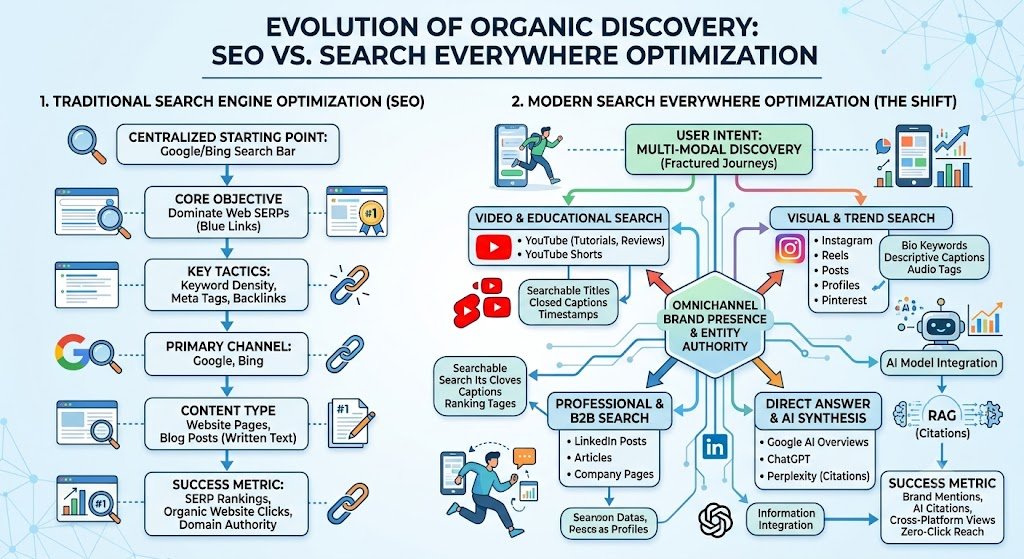
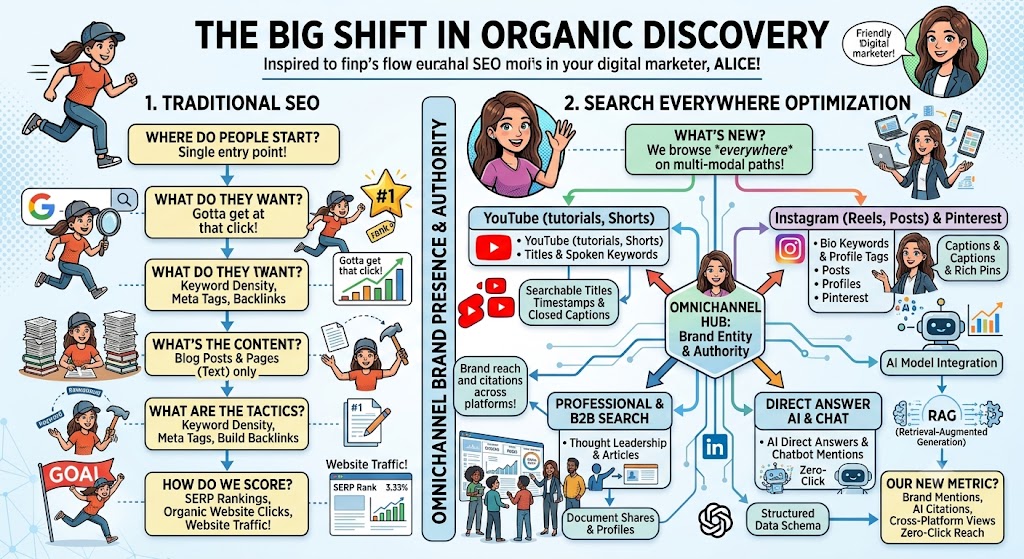
The core difference between Search Engine Optimization (SEO) and Search Everywhere Optimization comes down to ecosystem scope and user discovery behaviour.
While SEO focuses on dominating traditional web-based search engines, Search Everywhere Optimization (often called SEO 2.0 or Omnichannel Search) treats the entire internet as a decentralized search network.
Traditional SEO focuses almost exclusively on web-based search engines like Google and Bing. Its primary goal is to capture organic clicks by ranking web pages for specific keyword queries on a traditional Search Engine Results Page (SERP). Optimization revolves around on-page keyword density, site architecture, and building domain authority through backlinks.
Search Everywhere Optimization, by contrast, treats the modern internet as a decentralized search ecosystem. It recognizes that discovery no longer happens on a single browser homepage; users actively search for reviews on YouTube, solutions on LinkedIn, lifestyle trends on Instagram, community opinions on Reddit, and direct synthesized answers inside AI models like ChatGPT and Google AI Overviews.
Instead of optimizing just for blue links and site traffic, Search Everywhere Optimization ensures a brand is discoverable, cited, and recommended across every platform where consumer decisions are made. It shifts the focus from simple text keywords to holistic entity authority, multi-format content distribution (video, carousels, structured text), and zero-click brand citations. While SEO builds your website foundation, Search Everywhere Optimization ensures your brand dominates the entire modern user journey.
|
Feature |
Search Engine Optimization (SEO) |
Search Everywhere Optimization |
|
Primary Scope |
Web-based search engines (Google, Bing, Yahoo). |
All digital platforms with search bars or discovery feeds. |
|
Target Platforms |
Google, Bing. |
YouTube, Instagram, LinkedIn, Pinterest, Reddit, Quora, ChatGPT, Perplexity, and AI Overviews. |
|
User Intent Focus |
Keyword queries typed into a search bar. |
Multi-modal intent (visual planning, direct QA, short video reviews, career networking). |
|
Success Metrics |
SERP rankings, organic website clicks, domain authority. |
Brand citations, AI model mentions, cross-platform views, and zero-click brand reach. |
|
Primary Content Format |
Written blog posts, landing pages, technical site code. |
Short/long video, image carousels, PDF slides, forum answers, and structured text. |
|
Indexing Mechanism |
Web crawlers scanning HTML text & backlinks. |
LLM RAG pipelines, social metadata, closed captions, profile tags, and engagement signals. |