
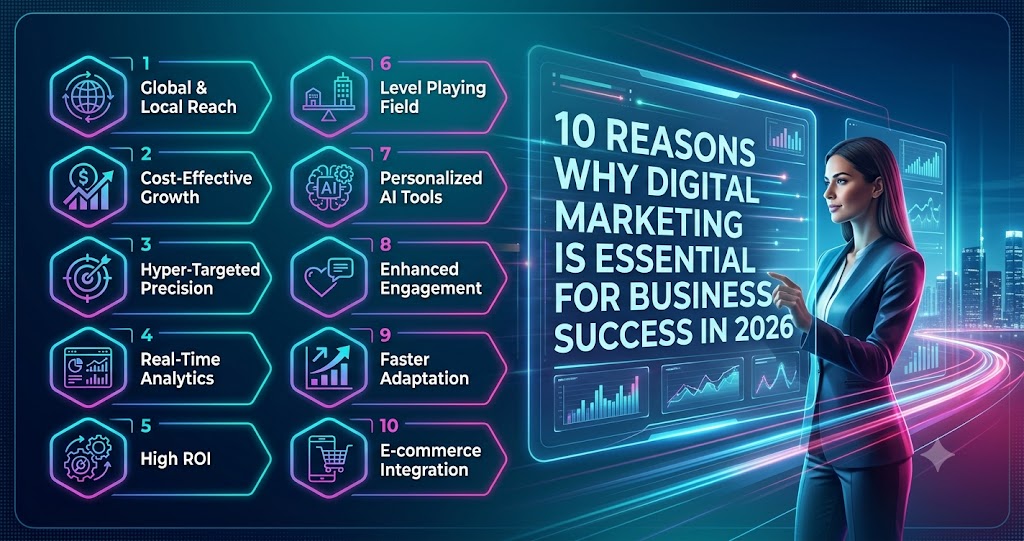
10 Reasons Why Digital Marketing Is Essential
Introduction
Not too long ago, traditional marketing held absolute authority over brand strategy. Expanding a business meant securing prime billboard space along major highways, purchasing expensive thirty-second television spots during peak viewing hours, or printing glossy flyers for direct mail drops. These legacy tactics offered wide exposure, but they shared fundamental limitations: immense upfront capital requirements, poor audience precision, and an almost complete inability to measure exact return on investment (ROI).
Today, the modern business environment looks radically different. Consumer habits have permanently shifted toward digital-first touchpoints. Whether discovering a local business via mobile search, evaluating products through short-form video content, or receiving hyper-relevant updates in an email inbox, modern consumers interact with brands through online channels before making purchasing decisions.
+---------------------------------------------------------------------------+
|                       TRADITIONAL VS. DIGITAL                             |
+---------------------------------------------------------------------------+
|  TRADITIONAL MARKETING                DIGITAL MARKETING                   |
|  * Static & One-Way Broad Channel     * Dynamic, Two-Way Engagement       |
|  * High Fixed Capital Upfront         * Scalable Budgeting                |
|  * Generalized Audience Reach         * Hyper-Targeted Segmentation       |
|  * Delayed & Inexact Metrics          * Real-Time Analytics & Attribution |
+---------------------------------------------------------------------------+
As digital ecosystems become increasingly integrated into everyday life, digital marketing has evolved from an experimental division of corporate strategy into the primary growth driver for sustainable revenue. It is no longer enough to maintain an idle website or post sporadically on social channels. Succeeding in today’s marketplace requires an active, data-informed strategy that meets consumers precisely where they spend their time and attention.
Below are the 10 core reasons why digital marketing is essential for business success in 2026—and how taking advantage of these strategies provides a lasting competitive advantage.
1. Unmatched Global and Local Reach
One of the most transformative aspects of digital marketing is its ability to dissolve traditional geographic barriers without demanding enterprise-level capital investment.
Expanding Beyond Geographic Limits
Under traditional models, a regional business looking to sell nationally or internationally faced massive logistics and media buying costs. Digital marketing eliminates these barriers. Through search engine optimization (SEO), cross-border e-commerce setups, and global performance ad campaigns, a business operating from a modest facility can market products and services to buyers anywhere in the world.
                               [ Your Business ]
                                        |
       +--------------------------------+--------------------------------+
       |                                                                 |
 [ Local Search (SEO) ]                                     [ Global Performance Ads ]
       |                                                                 |
       v                                                                 v
 (Nearby Customers)                                            (International Buyers)
By removing physical boundary limitations, brands can expand their addressable market, build international audience segments, and diversify revenue streams across different geographic regions.
Precision Local Discovery
Global reach does not come at the expense of local relevance. For brick-and-mortar retailers, service providers, and regional franchises, local digital marketing drives foot traffic and community engagement.
Local Search Optimization: Claiming and optimizing digital business listings ensures that high-intent local queries—such as “best HVAC repair near me” or “organic cafe open now”—lead directly to your business profile.
Geofenced Advertising: Mobile location technology allows brands to deliver contextually relevant offers to users present in specific geographic radiuses, such as trade shows, commercial districts, or competitor venues.
By combining broad international accessibility with tailored local visibility, digital marketing offers reach that traditional media cannot match.
2. Cost-Effective Growth Compared to Traditional Media
Marketing budgets are constantly scrutinized, making efficient capital allocation crucial for long-term survival. Digital marketing provides superior cost efficiency and operational flexibility compared to traditional print, radio, or broadcast avenues.
Scalable Entry Points for Every Capital Level
Traditional advertising media require large, upfront capital commitments. Print magazines, billboard companies, and television networks demand fixed fees regardless of campaign performance or total conversions generated.
+-----------------------------------------------------------------------+
|                          FLEXIBLE BUDGETING                           |
+-----------------------------------------------------------------------+
|  Pay-Per-Click (PPC)  --> Pay only when a prospect clicks.            |
|  Social Ads           --> Adjust daily caps based on live ROI.        |
|  Content & SEO        --> Build long-term organic equity.             |
+-----------------------------------------------------------------------+
Digital channels offer complete budget flexibility:
Pay-Per-Click (PPC): Advertisers only incur charges when a prospect actively clicks an ad link, ensuring spend correlates directly with traffic generation.
Dynamic Bidding: Campaigns on platforms like Google, Meta, and LinkedIn can run on custom daily caps, allowing businesses to start with modest budgets and scale investment only when positive performance is proven.
Compound Organic Equity: Inbound strategies like content marketing and organic search demand upfront effort, but continue to generate qualified traffic for months or years without ongoing cost-per-click charges.
| Marketing Metric / Feature | Traditional Marketing (Print, TV, Radio) | Digital Marketing (SEO, PPC, Social) |
| Upfront Capital Requirements | High fixed costs; non-refundable contracts | Highly scalable; start with flexible budgets |
| Targeting Capability | Broad demographic estimates | Granular (intent, behavior, demographics) |
| Performance Visibility | Estimates, post-campaign surveys | Real-time tracking and continuous attribution |
| Agility & Edits | Static; impossible to change post-launch | Dynamic; update creative and copy instantly |
| Conversion Mechanics | Indirect (requires manual customer action) | Direct (one-click purchasing, instant forms) |
Because every digital dollar can be controlled, tracked, and reallocated instantly, businesses achieve significantly higher resource efficiency.
3. Hyper-Targeted Precision and Audience Segmentation
Traditional mass-media channels broadcast messages to broad, unverified audiences. A billboard on a busy highway is seen by thousands of drivers daily, but only a small fraction represent your ideal customer profile. Digital marketing replaces this broad approach with precise audience targeting.
       [ TRADITIONAL BROADCAST ]                  [ DIGITAL HYPER-TARGETING ]

            o  o  o  o  o                             .  .  .  .  .
          o  o  o  o  o  o                          .  .  [TARGET] .  .
            o  o  o  o  o                             .  .  .  .  .
     (Unfiltered Mass Audience)                  (Exact Intent & Demographics)
Granular Audience Profiling
Modern marketing platforms allow organizations to filter campaign delivery using rich contextual data points, ensuring ads are only shown to users who match specific buying criteria:
Intent-Based Targeting: Capturing users actively searching for specific solutions (e.g., matching search keywords with exact product offerings).
Demographic & Professional Attributes: Filtering by job title, industry sector, company size, age, household income, or education level.
Behavioral Signals: Engaging prospects based on past online activity, such as visit history, abandoned cart actions, or content downloads.
Psychographic Traits: Aligning creative messaging with explicit user interests, values, lifestyles, and brand affinities.
Reducing Ad Spend Waste
When messaging is tailored to specific audience segments, conversion rates increase and acquisition costs fall. Instead of spending resources on unqualified audiences, brands focus their budgets entirely on high-converting prospects. This level of precision elevates brand perception, turning marketing from an intrusive interruption into a helpful solution.
4. Real-Time Analytics and Measurable Performance
The legacy marketing era was defined by John Wanamaker’s famous quote: “Half the money I spend on advertising is wasted; the trouble is I don’t know which half.” Digital marketing eliminates this uncertainty through complete operational transparency and real-time analytics tracking.
-------------------------------------------------------------------------+
|                    DATA-DRIVEN METRIC DASHBOARD                        |
+------------------------------------------------------------------------+
|  Metric                     | Strategic Business Insight               |
+-----------------------------+------------------------------------------|
|  Conversion Rate (CR)       | Percentage of site visitors taking action|
|  Customer Acquisition (CAC) | Total marketing cost to gain one client  |
|  Customer Lifetime Value    | Long-term revenue generated per user     |
|  Return on Ad Spend (ROAS)  | Direct revenue return per dollar spent   |
+-----------------------------+------------------------------------------|
Eliminating Guesswork with Clear Attribution
Digital ecosystems capture user interactions across the entire buyer journey. Advanced analytic dashboards monitor traffic sources, user click paths, engagement times, and conversion events.
Key metrics include:
Cost Per Acquisition (CAC): Calculating the precise marketing investment required to acquire a paying customer.
Return on Ad Spend (ROAS): Tracking direct revenue generated from specific paid campaigns.
Conversion Rate Optimization (CRO): Identifying high-performing landing pages and optimizing underperforming user touchpoints.
Customer Lifetime Value (LTV): Measuring the long-term revenue generated by customers acquired through specific acquisition channels.
Agile Campaign Optimization
Real-time monitoring enables rapid strategic adjustments. If a creative variation underperforms, it can be paused immediately. If a specific keyword or audience segment shows strong conversion rates, campaign budgets can be shifted in real time to maximize performance. This continuous feedback loop ensures marketing strategies adapt swiftly to live market responses.
5. High ROI Through Omnichannel Campaigns
Modern buyers do not follow a linear path to purchase. A typical decision journey might begin with an educational blog post discovered via organic search, continue through a retargeting ad on social media, deepen via an automated email sequence, and culminate in a purchase through a direct search campaign.
Digital marketing allows brands to build omnichannel ecosystems where these channels work together cohesively, compounding returns across every touchpoint.
                     [ Prospect Discovery ]
                                   |
         +-------------------------+-------------------------+
         v                                                   v
  (Organic Search / SEO)                              (Social Media Discovery)
         |                                                   |
         +-------------------------+-------------------------+
                                   v
                      [ Educational Content Hub ]
                                   |
                                   v
                      [ Automated Email Nurture ]
                                   |
                                   v
                     [ Retargeting & Direct Search ]
                                   |
                                   v
                         [ Closed Sale / Conversion ]
The Compounding Effect of Channel Synergies
When marketing channels are managed in isolation, effectiveness drops. Integrated digital campaigns create multi-touch nurture journeys:
SEO and Content Marketing: High-ranking educational articles capture top-of-funnel traffic, establishing authority and capturing newsletter sign-ups.
Email Automation: Segmented email sequences nurture prospects over time with relevant case studies, product comparisons, and promotional offers.
Paid Retargeting: Retargeting campaigns keep your brand top-of-mind for users who engaged with your site but have not yet converted.
Social Proof & Reviews: User-generated content and social reviews reinforce trust right when buyers are making their final decision.
Maximizing Lifetime Value (LTV)
An integrated digital ecosystem does more than lower Customer Acquisition Costs (CAC)—it significantly increases Customer Lifetime Value (LTV). Automated post-purchase engagement, personalized loyalty offers, and tailored cross-sell recommendations turn one-off transactions into long-term customer relationships, maximizing revenue per user.
6. Leveling the Playing Field for Small and Growing Businesses
In the era of traditional media, market dominance belonged almost exclusively to enterprise corporations with massive advertising budgets. Independent businesses, startups, and mid-sized enterprises simply could not compete for prime television slots or national print placements.
Digital marketing changes these dynamics by prioritizing relevance, speed, and strategic focus over pure capital size.
------------------------------------------------------------------------+
|                      AGILITY VS. UNLIMITED BUDGET                     |
+-----------------------------------------------------------------------+
|  ENTERPRISE ADVANTAGE:                                                |
|  * Massive Capital Spend  * Broad Brand Recognition                   |
|                                                                       |
|  EMERGING BRAND ADVANTAGE:                                            |
|  * Rapid Content Execution * Niche Community Engagement               |
|  * Hyper-Specific SEO      * Fast Adaptation to Trends                |
+-----------------------------------------------------------------------+
How Emerging Brands Outmaneuver Legacy Giants
In search engines and social feeds, algorithms favor content quality, search intent match, and user engagement over company size.
Niche SEO Dominance: A local or specialized business can capture high-intent buyers by targeting long-tail keywords that larger competitors overlook.
Authentic Content & Storytelling: Smaller brands can build direct, authentic connections on social channels faster than bureaucratic corporate structures can approve campaigns.
Hyper-Local Targeting: Regional businesses can focus their advertising spend within exact geographical radiuses, ensuring zero wasted coverage compared to broad media broadcasts.
By using data-driven, agile strategies, growing businesses can establish strong market positions, capture market share, and compete directly with industry leaders.
7. Personalization at Scale with Modern AI Tools
Today’s consumers expect personalized brand interactions. Generic, mass-broadcast advertising is increasingly ignored. Modern digital marketing enables organizations to deliver tailored experiences to thousands of individual prospects simultaneously.
                          [ Raw Audience Data ]
                                    |
                                    v
                       [ AI Predictive Engine ]
                                    |
         +--------------------------+--------------------------+
         v                                                     v
  (Tailored Email Triggers)                             (Dynamic Web Content)
         |                                                     |
         v                                                     v
  "User-Specific Offer"                                 "Recommended Products"
Delivering Contextually Relevant Experiences
Personalization goes far beyond adding a first name to an email subject line. Advanced marketing automation engines analyze real-time user behavior, browsing history, purchase patterns, and lifecycle stages to deliver contextually relevant interactions:
Dynamic Web Content: Website landing pages automatically adjust headlines, hero images, and featured case studies based on the visitor’s industry or previous interactions.
Behavior-Triggered Messaging: Automated workflows send targeted recommendations when a user abandons a cart, views a pricing page multiple times, or reaches a product usage milestone.
Predictive Product Recommendations: E-commerce engines analyze historic purchase data to display personalized cross-sell and upsell suggestions that raise Average Order Value (AOV).
By delivering the right message to the right user at the right moment, personalization improves user experience, builds brand affinity, and drives higher conversion rates.
8. Enhanced Customer Engagement and Brand Loyalty
Traditional media is inherently one-way: brands broadcast messages at audiences without receiving immediate feedback. Digital marketing transforms audience communication into a two-way dialogue, fostering active communities and deeper brand loyalty.
       [ TRADITIONAL ONE-WAY ]                      [ DIGITAL TWO-WAY ]

    [ Brand ] ------> [ Audience ]               [ Brand ] <=======> [ Audience ]
       (Static Broadcast)                           (Interactive Feedback Loop)
Building Active Brand Communities
Modern channels provide immediate, direct communication paths between businesses and their customer bases:
Social Interaction: Active social media management turns comments, direct messages, and brand mentions into touchpoints for building trust and community.
User-Generated Content (UGC): Encouraging customers to share reviews, unboxing videos, and real-world usage photos creates authentic social proof that influences prospective buyers.
Real-Time Customer Support: Integrating live chat and social support channels resolves presales questions and post-purchase inquiries quickly, lowering churn and raising retention rates.
When customers feel heard and valued, they move from passive buyers to active brand advocates, driving word-of-mouth referral growth.
9. Faster Adaptation to Market Shifts and Trends
Market dynamics, consumer preferences, and economic conditions change rapidly. A major vulnerability of traditional marketing is its long production timelines and fixed commitments. A print magazine campaign or billboard contract locked in months in advance cannot be altered if market conditions shift overnight.
Digital marketing provides unmatched strategic agility.
------------------------------------------------------------------------+
|                    RAPID TEST-AND-LEARN FEEDBACK                      |
+-----------------------------------------------------------------------+
|  1. Deploy Variation A & B  --> Launch instantly to live audience     |
|  2. Real-Time Data Review   --> Measure CTR, Conversion Rate, CAC     |
|  3. Reallocate Capital      --> Shift budget to winner in hours       |
+-----------------------------------------------------------------------+
Rapid A/B Testing and Strategy Pivots
Digital campaigns operate in real-time, allowing teams to test hypotheses, analyze audience reactions, and optimize performance continuously:
A/B Testing (Split Testing): Marketing teams can run multiple ad creatives, landing page layouts, or email subject lines simultaneously, letting real user data determine the winning variation.
Instant Messaging Adjustments: If market trends shift or a news event alters consumer sentiment, campaign copy and targeting can be updated in minutes.
Agile Capital Allocation: Budgets can be moved instantly from underperforming channels to high-performing campaigns, protecting marketing capital and maximizing efficiency.
This flexibility allows digital-first organizations to navigate market uncertainties and capitalize on emerging trends faster than slower competitors.
10. Seamless Integration with Modern E-Commerce and Social Commerce
The line between content consumption and commercial transaction has almost entirely disappeared. In modern digital ecosystems, product discovery, consideration, and purchase occur within the same digital environment—and often within the same app session.
      [ Discovery ] ---------> [ Consideration ] ---------> [ Purchase ]
     (Social Feed / Search)    (In-App Reviews & Video)     (1-Click Checkout)

     ===================================================================
                       ALL OCCURRING IN A SINGLE SESSION
Frictionless Path to Purchase
Digital marketing shortens the sales cycle by eliminating friction between the moment of interest and the point of transaction:
Social Commerce: Platforms like Instagram, TikTok, and Pinterest enable direct, in-app shopping features, allowing users to purchase products without leaving their content feeds.
High-Intent Search Integration: Search ads and Google Shopping listings connect consumers directly to optimized product checkout pages at the exact moment of search intent.
Instant Conversion Features: One-click checkouts, integrated digital wallets, and automated chat-assisted sales lower drop-off rates and turn immediate interest into revenue.
By aligning marketing messaging directly with streamlined purchasing options, digital strategies maximize conversion rates across every channel.
| Strategic Dimension | Traditional Marketing Focus | Integrated Digital Strategy |
| Primary Goal | Mass brand exposure and top-of-funnel awareness | Full-funnel acquisition, retention, and lifetime value |
| Communication Style | Static, one-way broadcast message | Dynamic, interactive two-way dialogue |
| Measurement Approach | Post-campaign estimates and surveys | Real-time multi-touch attribution and live analytics |
| Targeting Model | Broad regional or demographic estimates | Hyper-targeted intent, behavioral, and profile data |
| Operational Agility | Fixed, long-lead production schedules | Agile, real-time optimization and rapid testing |
Conclusion & Action Steps
Digital marketing is no longer just one component of a broader promotional toolkit—it is the foundational infrastructure for scalable business growth. From expanding brand reach across local and international markets to delivering personalized customer journeys driven by real-time analytics, digital channels offer efficiency, measurement, and agility that legacy methods cannot match.
Organizations that invest in structured, data-driven digital strategies build long-term competitive advantages. Conversely, businesses that rely solely on outdated marketing models risk losing visibility, market share, and relevance in an increasingly digital economy.
Strategic Implementation Checklist
To transform these principles into operational performance, consider these high-impact action steps:
-------------------------------------------------------------------------+
|                    30-DAY DIGITAL ACTION CHECKLIST                     |
+------------------------------------------------------------------------+
|  [ ] 1. Conduct a Digital Presence Audit                               |
|         Evaluate website speed, SEO health, and conversion paths.      |
|                                                                        |
|  [ ] 2. Consolidate Real-Time Analytics                                |
|         Ensure conversion tracking and attribution are active.         |
|                                                                        |
|  [ ] 3. Map Out Integrated Funnel Journeys                             |
|         Connect organic content with automated email nurture workflows.|
|                                                                        |
|  [ ] 4. Test Hyper-Targeted Paid Campaigns                             |
|         Run small-scale PPC or social campaigns to test audiences.     |
|                                                                        |
|  [ ] 5. Implement Continuous A/B Testing                               |
|         Test headlines, creatives, and CTAs to improve conversions.    |
+------------------------------------------------------------------------+
By systematically executing these steps, your brand can build a resilient, scalable digital growth engine designed to deliver measurable results.
Study Reference Link https://gemini.google.com/app/8fb8406e7340345d